
Pixel Gem Loop: Gem Coloring
Shinrays GamesPuzzle
4.833.00 Reviews
- Version
- 1.301
- Installs
- 100.00K
- Age Rating
- Everyone
Screenshots
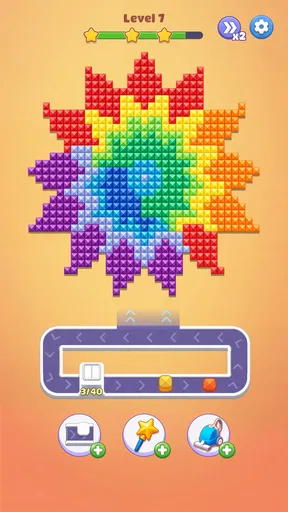
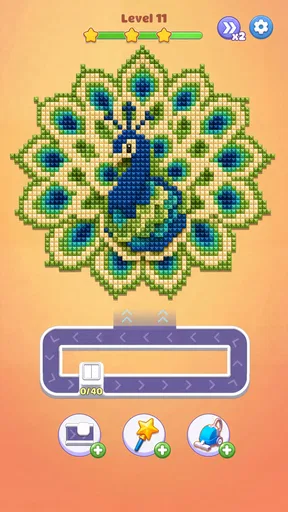
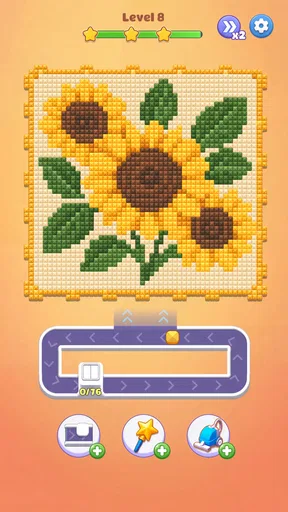
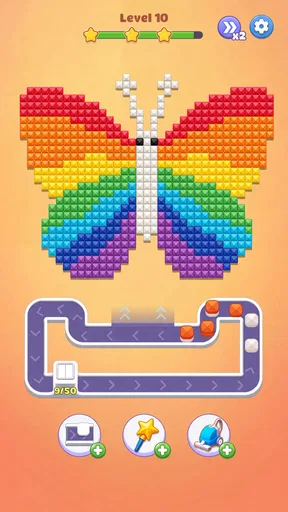
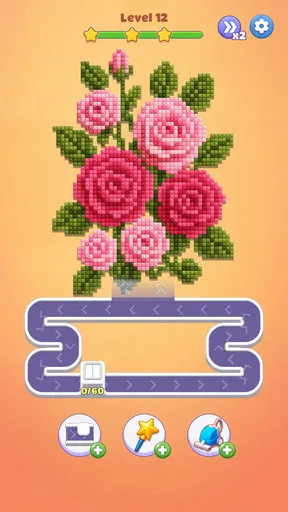
Our Review of Pixel Gem Loop: Gem Coloring
 Analysis by Appyee
I spent time with Pixel Gem Loop: Gem Coloring as a small, relaxing puzzle game rather than treating it like a serious strategy title. Its basic appeal is easy to understand: you work with jewel-like pieces, rotate or tap through patterns, and gradually complete pixel-art loops. The presentation aims for that satisfying ASMR feeling where small movements, colors, and completion sounds do most of the work.
That makes it a particularly easy game to pick up when I want something quiet. I do not need to learn a complicated story, manage a large collection, or remember a long chain of objectives. I can open it, solve a short pattern, and stop. At the same time, its simplicity is also the main thing to consider before installing it. Players looking for deep strategy, competitive rankings, or a large adventure may find the experience too focused.
How the coloring puzzles feel in everyday use
The game comes from Shinrays Games and sits in the puzzle category. It is free to download, with optional purchases listed from $1.99 to $99.99 per item. That combination immediately sets the right expectation: the basic experience is accessible, but spending may be part of the wider product design. I would approach it as a free casual game first and decide later whether any optional purchase genuinely improves my own routine.
The central loop is built around matching and filling visual shapes. Instead of asking me to calculate long combinations or memorize a board, it gives the hands something simple to do: spin, tap, observe the pattern, and complete the pixel-art image. The appeal is tactile more than intellectual. I enjoy the moment when an incomplete design begins to look coherent, especially when I slow down rather than tapping randomly.
One useful way to play is to treat each puzzle as a short reset between other tasks. After answering messages or waiting for an appointment, I can spend a few minutes completing a loop without committing to a lengthy session. That is where the game makes the most sense to me. It is not trying to replace a full evening game; it works better as a compact mental break.
The ASMR-style presentation also changes how I judge mistakes. In a faster matching game, I usually focus on speed and score. Here, the visual rhythm encourages patience. I watch how a piece fits into the larger design and use the next move to confirm the pattern. This is a small but important distinction: the game feels more comfortable when I play deliberately, while hurried tapping can make a straightforward puzzle feel needlessly messy.
Progress without turning every session into a test
For me, the strongest progress comes from recognizing the structure of a loop rather than simply reacting to individual gems. I first look for the sections that are already visually aligned, then work outward from those areas. This reduces the temptation to rotate everything at once. It is a practical habit that makes the board easier to read and gives the game a calmer pace.
A second useful approach is to pause after each clear visual change. When several pieces appear similar, I can easily lose track of which move created the improvement. Taking a moment to inspect the whole image helps me avoid undoing a good arrangement. That tip sounds obvious, but it matters in a game where the screen can become visually busy even though the rules remain simple.
I also prefer playing with a specific stopping point. Completing one satisfying image is more enjoyable than continuing automatically while my attention fades. Because the game is built around repeated puzzle interactions, a long session can begin to feel like variations on the same action. Short sessions protect the relaxing quality and make it easier to return later without feeling that I have turned a calming activity into a chore.
The pressure question is therefore personal. If I want a no-stakes puzzle that lets me experiment, this format works well. If I need constant novelty, escalating mechanics, or a strong sense of achievement, the loop may feel limited. The game’s appeal depends less on dramatic progression and more on whether I enjoy polishing one visual arrangement after another.
Where spending fits into the experience
The purchase range deserves attention because the smallest listed item and the largest listed item are very far apart. I would not assume that the most expensive option is necessary, useful, or good value for every player. A sensible approach is to play without spending first, notice whether the free routine already feels complete, and only consider an optional purchase when I understand exactly what I am receiving on the purchase screen.
This is especially important for a casual game. A low-cost impulse purchase can feel harmless, but repeated decisions across many sessions can change the total cost of a game that began as free. I would also avoid buying simply because I am stuck or impatient. In a puzzle built around observation, stepping away for a few minutes is often a better response than paying to remove a moment of friction.
From a fairness perspective, the presence of in-app purchases does not by itself tell me whether the game is generous or aggressive. What I can say is that the spending ceiling is substantial enough to justify caution. I would keep purchase confirmation enabled on my device, especially if children use the same phone or tablet. The age rating is Everyone, which makes that practical safeguard more important, not less.
I also like to separate enjoyment from completion. If a purchase helps someone access more of the visual content and they are happy with that exchange, it may be reasonable for them. But I would not treat spending as proof of skill, and I would not recommend buying before knowing whether the free portion provides enough variety for the intended player.
Is the puzzle experience fair?
Pixel Gem Loop: Gem Coloring is not the kind of game I would judge by competitive fairness in the same way as a multiplayer battle or ranked card game. There is no reason for me to expect a contest against other players from its core presentation. The more relevant question is whether the puzzle interaction itself gives me enough information to make a thoughtful decision.
In my experience, the visual approach encourages learning through inspection. I can compare the current arrangement with the intended pixel-art form and adjust my next move. That makes the game feel more like a visual sorting exercise than a test of reflexes. Players who dislike timers, rapid input, or pressure to beat another person may appreciate that slower relationship with the board.
There is still a trade-off. A gentle design can become less satisfying for someone who wants a measurable challenge. Without a strong competitive layer, my motivation comes from completion and visual neatness rather than proving that I am faster or more efficient than another player. That is fair for a relaxing puzzle, but it will not satisfy every definition of progress.
Compared with traditional match-three games, this title appears less focused on chaining colorful pieces for explosive effects and more focused on arranging a complete image. Compared with nonogram-style puzzles, it offers a more tactile, rotating-and-tapping feel rather than asking me to solve rows and columns through deduction. Compared with jigsaw apps, it replaces irregular pieces with a more compact pixel-art loop. Those differences matter: the best alternative depends on whether I want sound and motion, logic and certainty, or a more familiar board-clearing rhythm.
I would choose a conventional match-three game when I want fast feedback and larger combo moments. I would choose a nonogram when I want a puzzle with clearer logical constraints. I would choose this game when I want the visual satisfaction of gradually closing a pattern without making the session feel like an examination.
Who will enjoy it, and who should skip it?
This is a good fit for people who like colorful visual puzzles, short sessions, and a soothing rhythm. It can also work for someone who wants a simple activity while commuting, waiting for food, or winding down before bed. The Everyone age rating makes it broadly approachable, although younger players should still have purchase controls in place when using a shared device.
I would be more cautious recommending it to players who need a strong narrative, social competition, or a large strategic system. It is also not my first choice for someone who becomes frustrated by repeated small interactions or who wants every session to introduce a major new mechanic. The game’s charm comes from refinement and repetition, so that same quality may feel narrow to players who prefer constant surprise.
Another realistic use case is a shared family tablet. One person can solve a few patterns, hand the device to another person, and leave the game without needing to explain a complicated control scheme. The potential problem is spending: because the game is free and suitable for Everyone, I would make sure the device owner controls purchases before allowing unsupervised play.
Device fit, version, and practical expectations
The current version is 1.301, and the game supports devices running Android 6.0 or later. That minimum makes it available to people using older Android hardware, although actual comfort will still depend on the phone’s screen, touch response, and general condition. A small display may make similar-looking gems harder to distinguish, while a larger screen can make the pixel-art patterns easier to inspect.
I would play with the screen brightness at a comfortable level rather than turning it up simply to make colors look more vivid. The game’s visual appeal is central, but a bright screen can work against the relaxing purpose during an evening session. I would also keep the device steady when rotating pieces; quick, repeated taps are more likely to create confusion when I am holding the phone at an awkward angle.
The game has reached over 100,000 installs and holds a 4.8 average from around 2,600 ratings. Those figures suggest that many players respond positively to its particular style, though they do not guarantee that it will suit someone who wants a more demanding puzzle system. There are also 33 written reviews, which I would treat as useful individual impressions rather than a complete picture of every possible play style.
Its release date is July 9, 2026, so I would keep my expectations focused on the experience available now rather than assuming it has the long history or mature feature depth of an older puzzle franchise. That is not automatically a weakness. A focused game can be pleasant precisely because it does not carry years of accumulated systems, but players who value extensive content should make their decision based on whether the core loop itself is enough.
What I would check before committing money
My first check would be simple: can I enjoy several free sessions without feeling pushed to pay? If the answer is yes, the game is already doing its main job for me. I would then examine the wording and final amount of any purchase carefully, rather than relying on a button that suggests convenience or urgency.
My second check would be whether the visual puzzles remain comfortable over time. I would look for signs that I am solving thoughtfully or merely tapping through habit. If the latter happens, I would stop and compare the experience with a nonogram or a slower jigsaw app. A different puzzle format may provide more lasting interest without requiring any purchase.
My third check would be household suitability. On a personal device, the spending decision is mine. On a family device, I would make sure children cannot confirm purchases accidentally. The broad age rating makes the game approachable, but it does not remove the need for responsible device settings.
There is a useful trade-off here between convenience and control. A purchase may reduce friction, but preserving a slower pace can be part of the reason to play. I would rather keep the game as a small calming ritual than turn it into a system where I feel compelled to unlock every available option.
My trust verdict
I come away viewing Pixel Gem Loop: Gem Coloring as a focused, free puzzle for players who enjoy visual completion more than competition. Its spin-and-tap interaction is easy to understand, its pixel-art goal gives each board a clear purpose, and the ASMR-inspired mood makes it suitable for short breaks. I especially like it when I approach it patiently and stop after a satisfying completion.
My reservation is not about the basic idea; it is about longevity and spending discipline. Repeated visual loops may not provide enough variety for players who need ambitious progression, and the listed purchase range means I would not hand the game to a child without purchase protections. I would also avoid assuming that a high rating means it will replace a deeper puzzle favorite.
For me, the recommendation is straightforward: try the free experience, use the visual pattern as a reason to slow down, and decide about spending only after the game has earned a regular place in your routine. If you want a gentle pixel-art matching game for quiet moments, this is worth a look. If you want a competitive challenge, a story, or complex deduction, I would choose a different puzzle category instead.
My final advice is to judge it by the calm quality of one completed loop, not by the promise of endless progression. That is where this game feels most convincing, and it is also the clearest way to know whether its focused design is right for you.
Verdict
Strengths of Pixel Gem Loop: Gem Coloring
- Relaxing coloring gameplay suitable for short sessions.
- Simple controls make it accessible for beginners.
- Bright gem designs create satisfying visual results.
- Works well as a casual offline pastime.
- Gradual challenge keeps the experience easy to follow.
Limitations of Pixel Gem Loop: Gem Coloring
- Repetitive puzzles may lose appeal after extended play.
- Some designs can feel too similar to one another.
- Small details may be difficult to color on compact screens.
- Progress can feel slow without optional rewards or bonuses.
- Ads may interrupt the otherwise relaxing coloring experience.
Other Releases by Shinrays Games
View All


Similar Picks in This Category
View All
Block Blast!
HungryStudio4.8

Braindom: Brain Games Test
Lahana Game Studio4.6

AMAZE!
CrazyLabs LTD4.6

Sudoku - Classic Sudoku Puzzle
Oakever Games4.7

Art Puzzle - Puzzle Games
Easybrain4.8

Amaze GO!
Oakever Games4.9
Frequently Asked Questions
What is Pixel Gem Loop: Gem Coloring?
Pixel Gem Loop: Gem Coloring is a relaxing coloring game built around pixel-style artwork and colorful gem designs. You select a picture, choose the matching colors, and fill numbered or marked sections to complete the image. The gameplay is simple enough for casual players, while the collection of patterns and sparkling visual effects gives it a satisfying sense of progress as each design is finished.
How do you play Pixel Gem Loop: Gem Coloring?
To play, choose an available gem picture and zoom in on the pixel grid or individual sections. The game indicates which color belongs in each area, allowing you to tap and fill spaces until the design is complete. The controls are straightforward and do not require advanced gaming skills. It is mainly designed for short, relaxing sessions rather than fast-paced competition.
Is Pixel Gem Loop: Gem Coloring suitable for children?
The game is generally easy for children to understand because it uses simple tapping, color matching, and clearly defined artwork. However, parents should review the app’s age rating, advertisements, in-app purchase options, and privacy information before allowing younger children to play. If the app includes external links or optional purchases, parental supervision is recommended, especially on shared devices.
Does Pixel Gem Loop: Gem Coloring require an internet connection?
The basic coloring experience may work offline after the application and its necessary content have been installed, but some features can depend on an internet connection. Advertisements, new picture downloads, cloud-related functions, updates, or promotional content may not be available without connectivity. If offline play is important to you, test the game in airplane mode because requirements can vary by version and device.
Is Pixel Gem Loop: Gem Coloring free to download and play?
Pixel Gem Loop: Gem Coloring can generally be downloaded without an upfront charge, but free access may be supported by advertising or optional in-app purchases. Payments could relate to removing ads, unlocking additional artwork, or obtaining other bonuses. Before downloading, check the store listing for the current pricing and purchase details, and use device-level purchase restrictions if children will be using the app.
Play our best games!


